
Ask an Investor Anything: key insights on starting, raising and being a founder
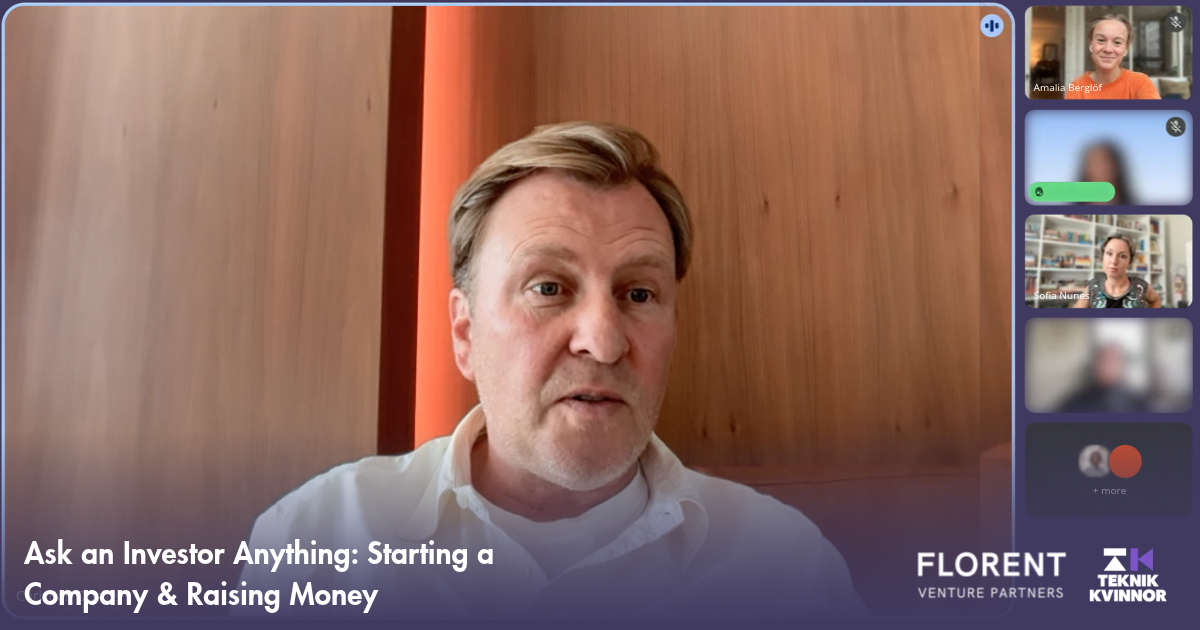
On 19 November we ran Ask an Investor Anything, an online AMA for women and non-binary people who want to start a company or take the one they have further. More than 100 questions came in beforehand. The session was built around three themes: starting, raising and being a founder. This is a recap of the questions that were asked and the insights from the day, for anyone who could not join - or want to dig into the insights again afterwards.
Our two guests:
Christian Dorffer has founded three software companies, and has been a full-time seed investor for 13 years. He runs Florent Venture Partners, a Nordic fund backing technical founders who build AI infrastructure and AI full-stack apps.
Sofia Nunes co-founded the fintech company Mambu and spent 12 years there until 2022. She now supports founders through their own journeys, working with funds including Florent.
The talk was moderated by our CEO Amalia Berglöf.
The room was split almost down the middle: 44% were still figuring out what to build, and 56% were already building. Here is what came up.
Starting
How do you know your idea is worth going for?
Christian and Sofia began with the same two tests, and neither involves building anything.
Is it a need-to-have or a nice-to-have? A nice-to-have is hard to charge for. Sofia put it simply: is the pain strong enough that customers will pay to get rid of it?
How many other horses are in the race? Most ideas come out of your own context, so plenty of other people have had the same one. Christian's tip is to assume 100 others are on it, some already funded, and to find out who they are before you judge your odds.
Then there is risk. If you can't afford much of it, keep your job while you do the research. Success usually takes many years, and most startups fail, often for reasons that have nothing to do with the idea being bad.
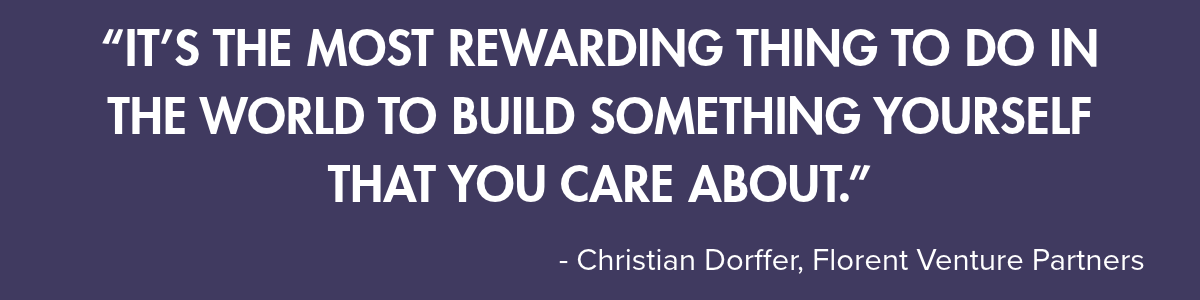
Also watch out for the problem that is only yours. Christian's first company was a mobile game for early childhood development, started when he became a stepfather. Parents turned out to be a tough group to get money from, and he has since been pitched about 20 times by new parents who want to build for parents. If you fund the company yourself, building something you care about is one of the most rewarding things you can do. If you want investors, the passion has to sit on top of a big business opportunity.
Sofia added that some of the best ideas come with real risk: they are new, heavily regulated, or have been tried before without success. Those can be worth chasing if you go in with open eyes.
Talk to customers first, or build first?
Christian's answer: if it is your first company and you can't afford to be wrong, start with conversations. Building first and showing people the result, the Steve Jobs way, works for risk takers who can afford the time.
The conversations do not need to be formal:
Meet potential buyers for coffee.
Give them choices: "If you had A, B or C, which would you choose and why?"
Ask whether they already spend money on software in this area, and what they worry about.
Christian also shared the anecdote when the urge for a problem statement has come from within: he worked with engineers who refused to write any code until the team could explain why the problem mattered.
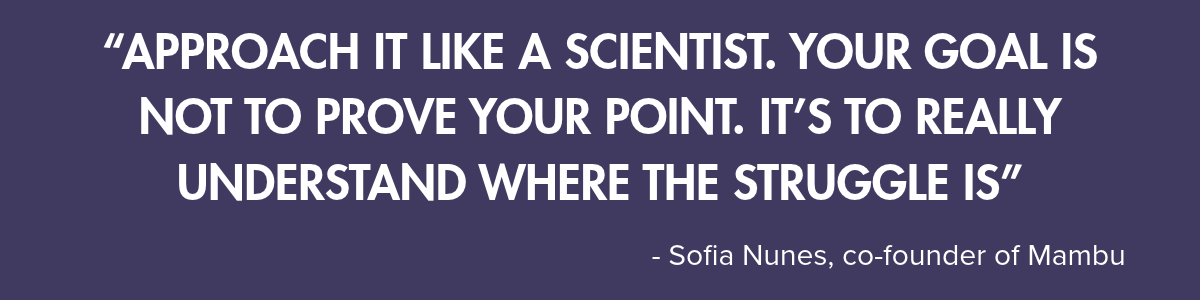
Sofia added that you should treat it as research and try to disprove your idea. Mambu started as a one-year master's capstone project. Her team went to Mozambique twice and spent over a month talking to banks, microfinance institutions and their clients. The brief was to test a mobile solution. What they found were deeper problems that a mobile solution would not fix, and that became the company. Her advice is to look for where the struggle is and stay open to problems you did not expect.
Two more things from Christian. What customers end up paying for may be version two or three of what you first built, so stay close enough to notice. And revenue can fund the journey. He told the story of a female unicorn founder in the US who struggled to raise money, so she spent her time with clients, built what they asked for and grew on revenue. When she sold the company, she owned a much bigger share than she would have after a venture round.
What if you are the target group yourself?
Then you already have a thesis. The next step, according to Christian, is to check whether other people in the group think like you. A large market buying a similar service usually splits into four or five segments, with different willingness to pay and different needs. You don't need 1,000 interviews. You need enough to see how varied the group is, and then you sort it into a few buckets that need different treatment.
How do you navigate a regulated market?
Customers first, then regulators. Christian talks to customers to confirm the problem. If your business depends on a regulation changing, you then talk to the regulators: is a change being discussed, is it on the horizon? He once passed on a Swedish online doctor startup because the state had not yet confirmed reimbursement. It did later, but he was not willing to bet on it.
Timing can work for you. If you know a rule is about to change, start your company three months before and you are first in.
Question the "never". Sofia often heard "our regulators will never allow this" at Mambu. The team kept asking why, starting from first principles. Some markets only needed time, because conversations were already going on. Others never opened and were a no-go. They did have an entry point from the start, and she called the early phase tough.
Start where you have an edge. One attendee pointed out that insurance-based systems in parts of Europe work differently from the Nordics, so another country might be an easier first market. Christian's view: if you found the problem in Sweden, track it there first. Most successful European founders start in Europe and move to the US once they know they are onto something. Some go through Y Combinator and it happens fast, others wait for a Series B of around $50 million, because starting in the US is expensive.
How do you find your first customers when the product is niche and the buyers are SLOW MOVERS?
Christian passes on many investments that are elegant technical products looking for a problem. Engineers often build first and find out afterwards that they were not close enough to customers.
Work out who the buyer or user is. Offer a free three-month trial, work closely with them, and fix the friction points they find.
If they keep using it, start charging. If they don't, you don't have product-market fit yet. Users who are really engaged tell other users, and that is the best early traction you can get.
Find the person on LinkedIn and invite them for coffee. It is a numbers game: maybe one in 10 replies, maybe one in 50. Send the messages anyway.
Sofia's warning from fintech: the buyer inside a bank, often in the IT department, may feel their own job is at risk from your product. Keep that in mind when you approach them, even if the fear is unfounded.
Raising
When should you start looking for investors, and will it take focus from building?
Christian started with how investors work. Building has become cheap, so there are more startups than ever. Florent sees around 3,000 deals a year and makes about 10, and those 10 tend to come from people the team already trusts.
So go to accelerators and startup events, meet people casually, and become a familiar face. Talk to investors when you are not fundraising. They need to know you and like you, and by the time you ask for money, half the battle should already be won. Think of it as a project of at least 12 months, aimed at the investors who will back you next year or the year after.
He also noted a pattern: men tend to pitch things they have not built yet, while women founders tend to wait until the product works and everything is ready. His suggestion was to shift that mindset a little in order to compete.
How do you find the investors who fit?
Spending time on investors who have never backed your space or stage is wasted time, even if they have money. Christian's method for building a target list:
Find the seed-stage companies in your sector and country that raised money in the last 24 months. An AI assistant can give you a first list.
Look up who invested in each one. The funding announcement on LinkedIn shows who liked it, and some of those people are investors.
Go to the events they go to. Use LinkedIn to find mutual connections and ask for a warm intro.
Present yourself as someone building in that space, in stealth, without mentioning that you are raising.
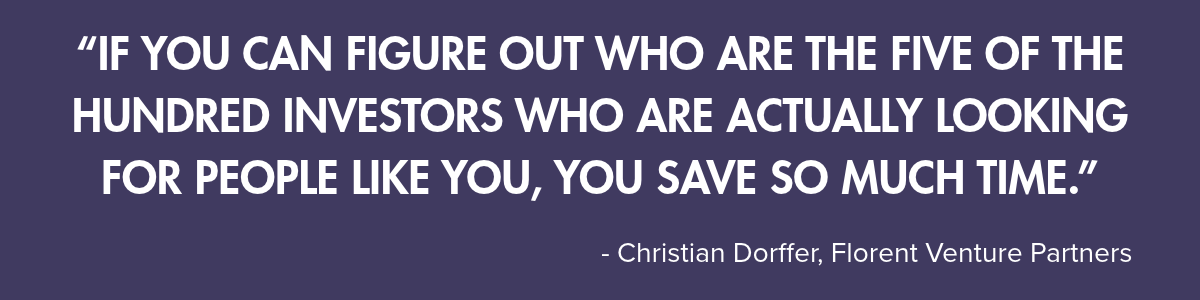
The payoff is skipping a hundred no's. If you find the five out of a hundred investors who are looking for people like you, you save yourself a lot of discouragement. Christian also offered to point people in the right direction on which investors to approach, depending on what they build and where they are.
How do investors judge an idea-stage hardware startup, when you need capital before you can show traction?
Hardware is not a business for every investor, but some investors love it. Christian's advice was to work backwards from similar companies, see who funded them, and join the communities those investors hang out in. He pointed to Startup Lab in Oslo, where around half the companies are in robotics or hardware and a monthly community event brings founders and investors together. You show up, share a pizza, and you are in the loop. That works better than cold outreach.
Is an idea enough, or do you need a prototype or proof of concept?
It depends on your track record. Founders who have built something impressive before and already know investors can raise on an idea. Unproven founders need to show it will work: a working product, users who speak highly of it, and in B2B perhaps letters of intent from customers who say they plan to use it. Revenue is not required.
Investors weigh the size of the opportunity against the risk. A strong track record lowers the risk, which means easier raises at higher valuations.
Can you raise money before you have worked out how users will pay?
Christian's rule of thumb is that investors want to see one of two things. Either the product is growing like crazy and monetisation can wait, or it already earns revenue and doubles every month, even from a small base. A product people try once and abandon is not a business.
His example was Peanut, a social network for mothers that went viral and reached around 400,000 members. He led the seed round, and it took a long time to figure out how to make money from it. Sofia described the other end of the spectrum: Mambu was never a viral product, and the team changed its pricing model close to ten times in the early years, partly to make it work for investors during fundraising.
Being a founder
How do you keep believing in your idea and yourself through all the no's?
This one showed up again and again in the pre-submitted questions, and both speakers had a lot to say.
Sofia: run a reality check on the market. Is this still a problem, and are there signs from the market that it is going somewhere? At Mambu, the seed round came after a working prototype and market validation, and it settled the doubts for a while. They returned a year to 18 months later. The runway was almost gone, talks with VCs were close but not close enough to land in time, and the three founders took salary cuts for three months. Some early employees offered to do the same. Her advice for those moments: stay focused and read the signals from customers and leads. A pivot can be small, like an expansion or a detour, and you don't have to change everything you offer.
Christian: keep the drive, and stay honest. You need a mindset of never giving up, and it is also sad to see founders hang on too long. He closed his own gaming company after three years, having sold his apartment and put his money into it, and he thinks now that he should have stopped two years earlier. His method:
Talk to founders who are further along in your space and ask which metrics they track every month.
Decide which metrics the business has to hit for it to work.
Point the whole team's innovation at hitting them.
If you still can't hit them after three to six months, be honest with yourself.
Some of his most successful founders have returned around 30% of the money to investors because they could not find a path. Experienced founders and investors respect that, because they know the odds.
Investors can be partners in this. Florent expects to write about 30 cheques and expects at least half of them to go to zero. That means the fund wants to work hard to prove itself right, and also to find out early if it is wrong. Institutional investors expect some startups to fail, so there is no need to worry that yours will break their hearts. The good version of the relationship, as Christian described it, is a conversation about where you need to be in three months and how he can help you get there. Small targets add up to the bigger ones that validate the business.
How do you build a lasting advantage when everyone has access to the same AI models? Do investors still back AI wrappers?
This question came in by email and in the chat. Christian's answer: Florent does not back companies that are only wrappers. A fund has 10 years before it has to return capital, and he does not want to back companies that may be redundant in two years. A different interface and language on top of a general model is hard to raise for, and it feels like a temporary opportunity.
His advice is to find a niche that the general-purpose models are unlikely to go after for a long time, and to go deeper there:
Regulated industries
Industries where most of the data is not publicly available
Companies that hesitate to share their data with the large AI providers
He also made a case for modest outcomes. A company with $10 million in annual revenue that has stopped growing can still be sold, and that can be a life-changing event for the founder.
Seven things to take with you
Test whether the problem is a need-to-have before you test the solution, and check who else is already working on it.
Interview customers like a scientist. Look for where the struggle is, and be ready to find a different problem than the one you came with.
Offer free pilots to the buyers you want, work with them, and charge once they keep using it. Expect a low reply rate and send the messages anyway.
Start meeting investors a year before you need money, and only the ones who back your sector and stage.
Show up at the communities where those investors gather. It works better than cold outreach.
Set monthly metrics and three-month targets, and be honest when they are not met.
Go deep in a niche that general AI models are slow to reach.
Have a follow up question?
Both are open to direct questions by DM or email. Thank you to everyone who joined and sent in questions!